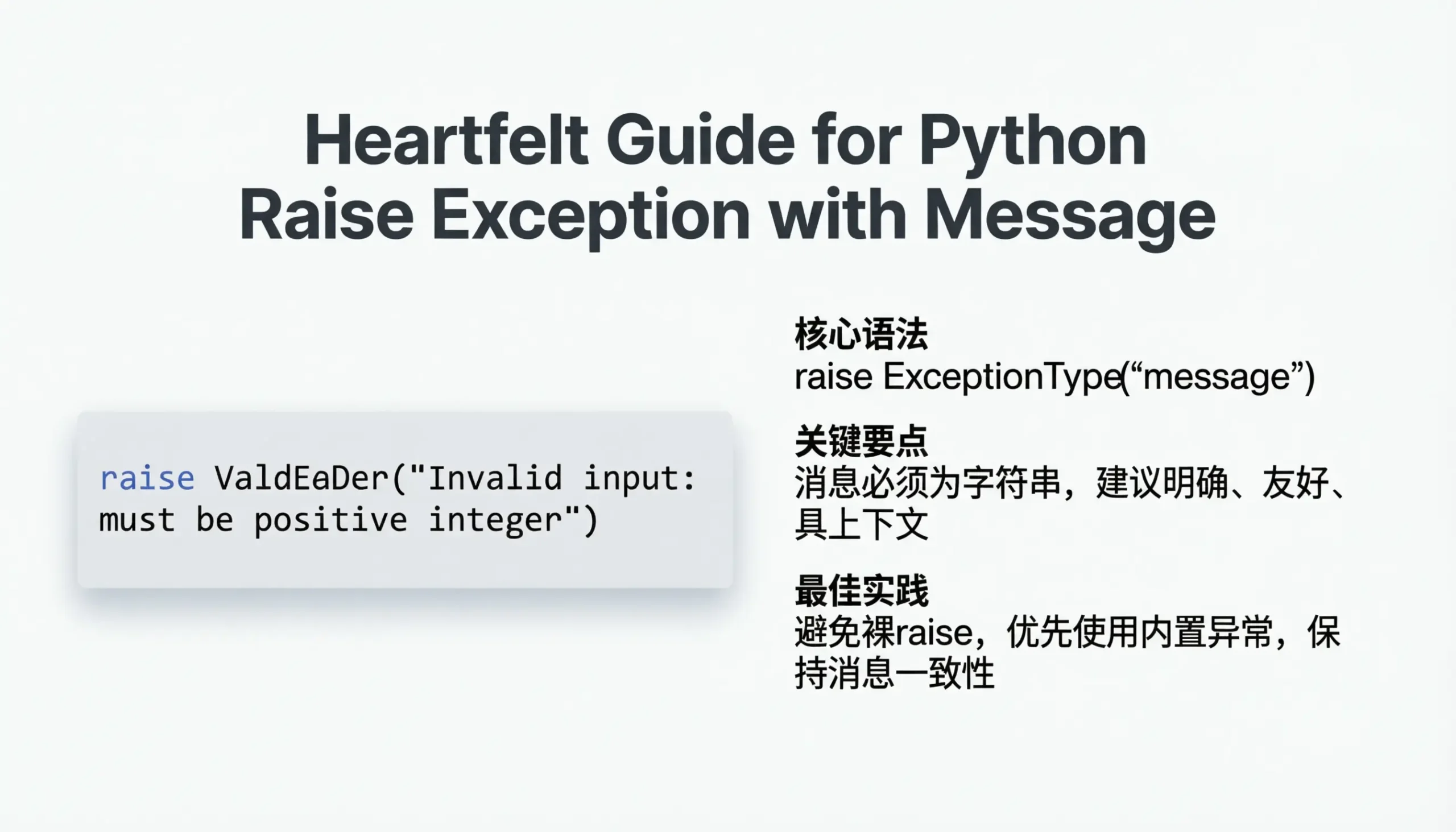
Introduction
If you’re searching for python raise exception with message, you’re likely trying to make your Python code more robust and meaningful. Errors happen to everyone — even the best developers. The key is not just catching them, but communicating clearly why something went wrong.
In Python, exceptions are your friend. They signal problems early, prevent bigger issues, and help other developers understand your intentions. But raising an exception without a clear, descriptive message is like shouting in an empty room — the problem remains unclear.
This post covers everything you need to know about raising exceptions with messages in Python. From basic syntax to best practices, you’ll get ready-to-use examples, tips for meaningful messages, and guidance for different scenarios. By the end, you’ll be able to write Python code that not only runs correctly but also speaks kindly to anyone reading your errors.
1. Basic Python Raise Exception with Message
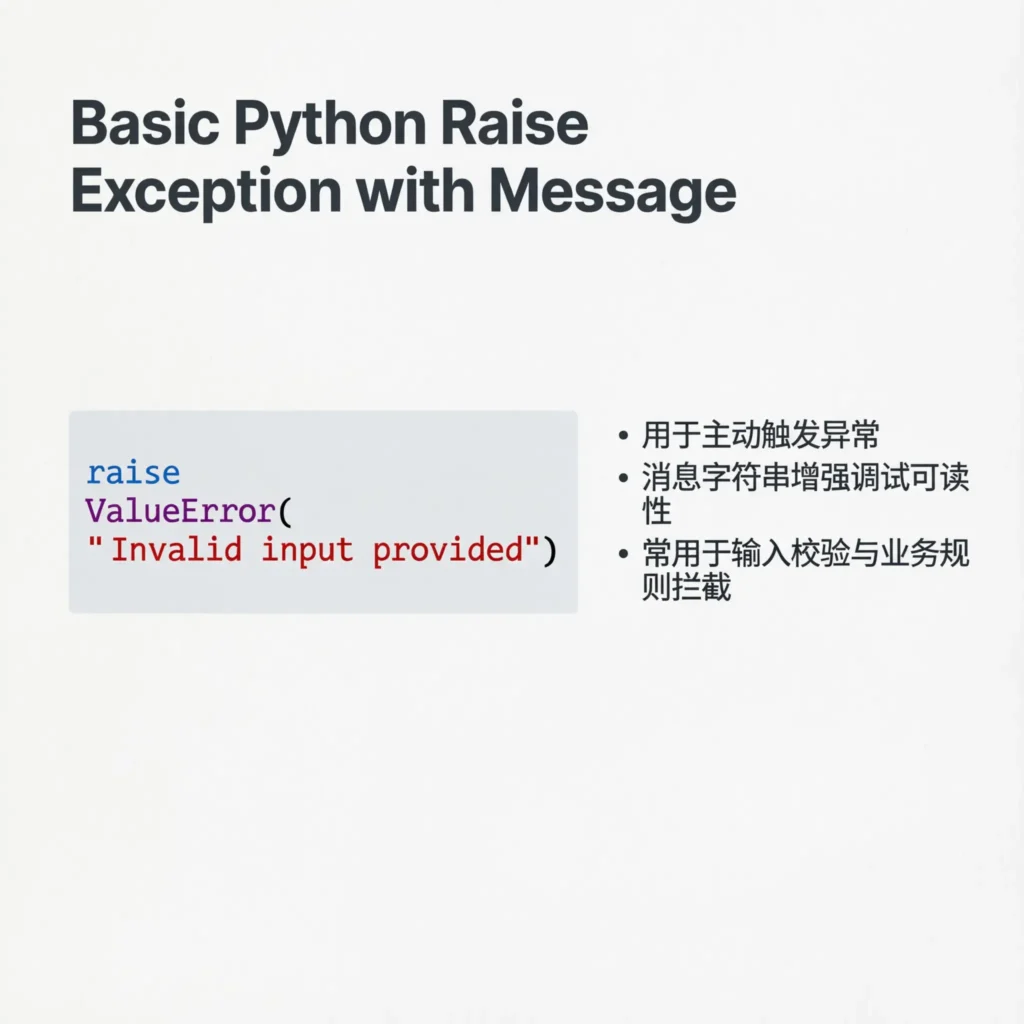
When you want to stop your program because something went wrong, a simple message makes your code clear and understandable.
Examples:
- Message:
raise Exception("Something went wrong!") - Message:
raise ValueError("Invalid input provided.") - Message:
raise TypeError("Expected a string, got a number.") - Message:
raise IndexError("Index out of range.") - Message:
raise KeyError("Key not found in dictionary.") - Message:
raise RuntimeError("Operation failed unexpectedly.") - Message:
raise AssertionError("Condition not met.") - Message:
raise FileNotFoundError("File could not be located.") - Message:
raise ZeroDivisionError("Cannot divide by zero.") - Message:
raise NotImplementedError("This feature is coming soon.")
2. Raising Exceptions for User Input
Input can be tricky — help users understand what went wrong with a friendly message.
Examples:
- Message:
raise ValueError("Please enter a number between 1 and 10.") - Message:
raise TypeError("Input must be a string.") - Message:
raise Exception("Input cannot be empty.") - Message:
raise ValueError("Age must be positive.") - Message:
raise KeyError("Option selected is invalid.") - Message:
raise Exception("Please follow the instructions carefully.") - Message:
raise ValueError("Username cannot contain spaces.") - Message:
raise TypeError("Password must be a string.") - Message:
raise Exception("Email format is incorrect.") - Message:
raise ValueError("Date cannot be in the past.")
3. Custom Exceptions with Messages
Sometimes you need a unique exception type to make your program clearer.
Examples:
- Message:
class MyError(Exception): pass→raise MyError("Custom error occurred!") - Message:
class LoginError(Exception): pass→raise LoginError("Login failed, try again.") - Message:
class PaymentError(Exception): pass→raise PaymentError("Payment processing failed.") - Message:
class ConfigError(Exception): pass→raise ConfigError("Configuration missing.") - Message:
class DataError(Exception): pass→raise DataError("Data format invalid.") - Message:
class FileError(Exception): pass→raise FileError("File could not be opened.") - Message:
class NetworkError(Exception): pass→raise NetworkError("Network connection lost.") - Message:
class APIError(Exception): pass→raise APIError("API response invalid.") - Message:
class InputError(Exception): pass→raise InputError("Input value unacceptable.") - Message:
class ValidationError(Exception): pass→raise ValidationError("Validation failed.")
4. Exceptions in Functions
Inside functions, raise meaningful messages to help debug quickly.
Examples:
- Message:
def divide(a, b): if b==0: raise ZeroDivisionError("Cannot divide by zero") - Message:
def greet(name): if not name: raise ValueError("Name cannot be empty") - Message:
def age_check(age): if age<0: raise ValueError("Age cannot be negative") - Message:
def login(user): if not user: raise Exception("User missing") - Message:
def get_item(items, idx): if idx>=len(items): raise IndexError("Index out of bounds") - Message:
def save_file(file): if file is None: raise FileNotFoundError("File not found") - Message:
def connect(url): if not url.startswith("http"): raise ValueError("Invalid URL") - Message:
def calculate(value): if value<0: raise Exception("Value must be positive") - Message:
def update_record(record): if not record: raise Exception("Record missing") - Message:
def fetch_data(key): if key not in dict: raise KeyError("Key missing")
5. Handling Exceptions Gracefully
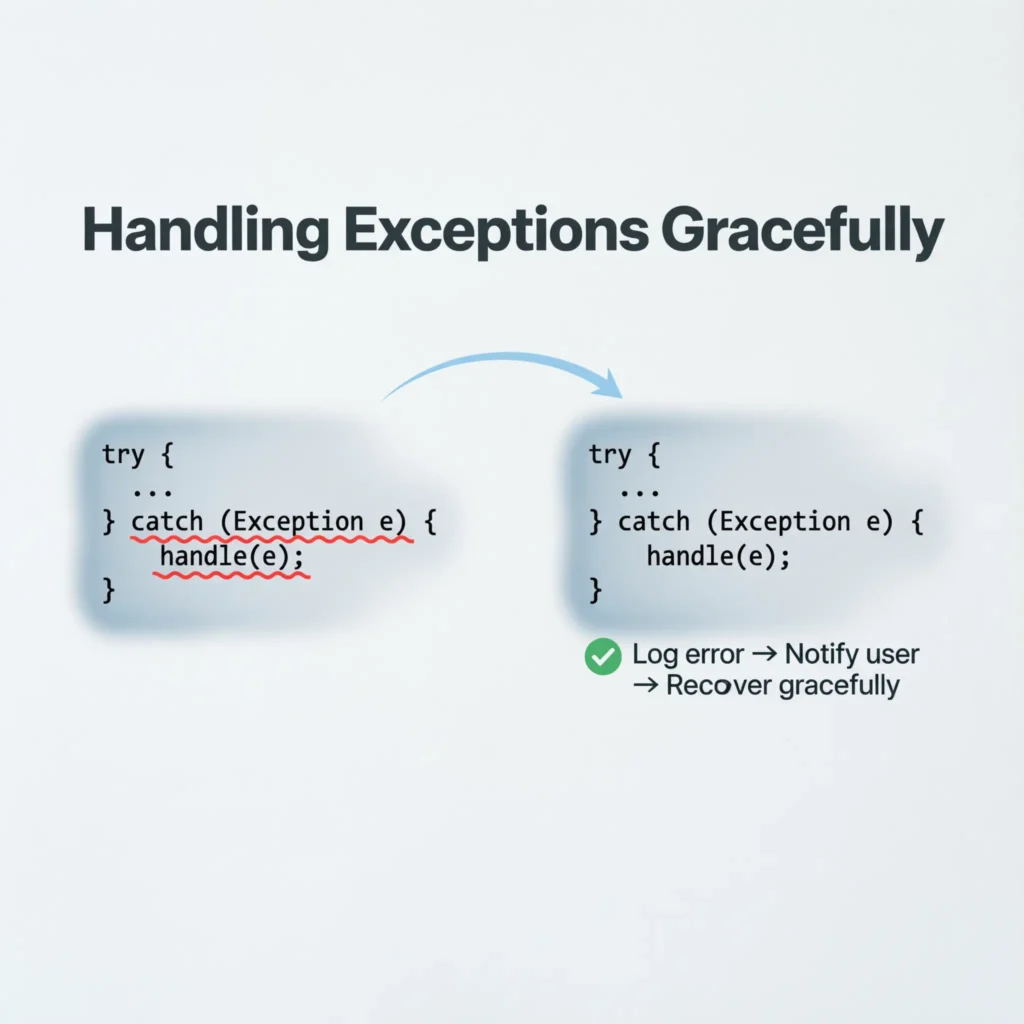
Sometimes it’s important to raise messages that guide, not scare.
Examples:
- Message:
raise Exception("Oops! Something went wrong, try again.") - Message:
raise ValueError("Check your input carefully.") - Message:
raise TypeError("Unexpected type, please correct it.") - Message:
raise IndexError("Out of range, please select valid index.") - Message:
raise KeyError("Key missing, please provide a valid one.") - Message:
raise RuntimeError("Operation could not complete, try later.") - Message:
raise AssertionError("Condition failed, please review.") - Message:
raise FileNotFoundError("File missing, please verify path.") - Message:
raise NotImplementedError("Feature coming soon.") - Message:
raise PermissionError("Access denied, check credentials.")
6. Python Raise Exception with Message in Loops
In loops, stop execution meaningfully when an issue occurs.
Examples:
- Message:
for i in data: if i<0: raise ValueError("Negative number found") - Message:
for user in users: if not user.active: raise Exception("Inactive user found") - Message:
for item in items: if item is None: raise Exception("Missing item detected") - Message:
for n in numbers: if n>100: raise ValueError("Number too large") - Message:
for file in files: if not os.path.exists(file): raise FileNotFoundError("File missing") - Message:
for key in dict: if key==None: raise KeyError("Key cannot be None") - Message:
for value in data: if type(value)!=int: raise TypeError("Expected integer") - Message:
for score in scores: if score<0: raise Exception("Invalid score") - Message:
for email in emails: if "@" not in email: raise ValueError("Invalid email") - Message:
for record in records: if record=={}: raise Exception("Empty record")
7. Raising Multiple Exceptions
Sometimes you need different messages for different problems.
Examples:
- Message:
if not username: raise ValueError("Username missing") - Message:
elif not password: raise ValueError("Password missing") - Message:
elif len(password)<6: raise ValueError("Password too short") - Message:
elif " " in username: raise ValueError("No spaces allowed in username") - Message:
elif not email: raise ValueError("Email missing") - Message:
elif "@" not in email: raise ValueError("Invalid email") - Message:
elif age<0: raise ValueError("Invalid age") - Message:
elif age>120: raise ValueError("Age too high") - Message:
elif score<0: raise ValueError("Negative score") - Message:
elif score>100: raise ValueError("Score exceeds max")
8. Python Raise Exception with Message in Classes
Classes can use exceptions to guide correct usage.
Examples:
- Message:
class Person: def __init__(self, name): if not name: raise ValueError("Name required") - Message:
class BankAccount: def deposit(self, amt): if amt<=0: raise ValueError("Deposit must be positive") - Message:
class BankAccount: def withdraw(self, amt): if amt>self.balance: raise Exception("Insufficient funds") - Message:
class Car: def set_speed(self, speed): if speed<0: raise ValueError("Speed cannot be negative") - Message:
class User: def set_email(self, email): if "@" not in email: raise ValueError("Invalid email") - Message:
class Product: def __init__(self, price): if price<0: raise ValueError("Price cannot be negative") - Message:
class Order: def add_item(self, item): if not item: raise Exception("Item cannot be empty") - Message:
class Inventory: def remove_item(self, item): if item not in self.items: raise KeyError("Item not found") - Message:
class Flight: def set_seats(self, num): if num<0: raise ValueError("Seats cannot be negative") - Message:
class School: def enroll(self, student): if student in self.students: raise Exception("Student already enrolled")
9. Logging Exceptions with Messages

Combine raise messages with logging for clarity and debugging.
Examples:
- Message:
import logging; logging.error("Invalid input"); raise ValueError("Invalid input") - Message:
logging.warning("File missing"); raise FileNotFoundError("File missing") - Message:
logging.info("User not active"); raise Exception("Inactive user") - Message:
logging.error("Network error"); raise ConnectionError("Network down") - Message:
logging.warning("Password weak"); raise ValueError("Weak password") - Message:
logging.info("Attempted access denied"); raise PermissionError("Access denied") - Message:
logging.error("Data invalid"); raise ValueError("Invalid data") - Message:
logging.warning("Division by zero"); raise ZeroDivisionError("Cannot divide by zero") - Message:
logging.error("Unsupported operation"); raise NotImplementedError("Feature coming soon") - Message:
logging.info("Operation failed"); raise RuntimeError("Operation failed")
10. Best Practices for Python Raise Exception with Message
A meaningful message is short, clear, and helpful.
Examples:
- Message:
"Input cannot be empty" - Message:
"Expected integer, got string" - Message:
"File not found, check path" - Message:
"Index out of range" - Message:
"Operation failed, try again" - Message:
"Invalid email format" - Message:
"User not authorized" - Message:
"Password too short" - Message:
"Value must be positive" - Message:
"Feature not yet implemented"
Conclusion
Raising exceptions in Python is more than just stopping your code — it’s about communicating clearly and kindly. A well-crafted message guides you and anyone reading your code through errors and unexpected situations.
By using python raise exception with message, you make your code robust, readable, and professional. Whether it’s a simple input check, a function guard, or a custom class, the right message can save hours of debugging and frustration.
Now that you’ve seen practical examples for every scenario, you can start adding friendly, meaningful, and precise messages to your Python exceptions. Keep your code clear, helpful, and developer-friendly — your future self (and teammates) will thank you.
FAQ
Q1: Can I raise multiple exceptions at once?
A: No, Python raises one exception at a time. Handle multiple cases sequentially.
Q2: Do exception messages affect program performance?
A: Minimal impact. Focus on clarity; messages help debugging more than they slow execution.
Q3: Can I use f-strings in exception messages?
A: Yes! Example: raise ValueError(f"Invalid value: {value}")
Q4: Should I always create custom exceptions?
A: Only for specific, reusable cases. Standard exceptions are fine for common errors.
Q5: How detailed should my messages be?
A: Short, clear, and helpful — explain the problem without overloading information.